*This post may contain affiliate links for which I earn commissions.*
High-pressure water is the easiest method of cleaning dirt or algae from a house, deck, patio furniture, sidewalk, or driveway. My patio furniture would never be clean without one. Any realtor will explain that a good cleaning instantly increases the value of your home, and a dirty sidewalk will cost you thousands of dollars in curb appeal.
Indeed, renting a power washer is an option. You'll pay at least $40 a day to rent a pressure washing in Florida. That's 40% of the cost to buy an average electric unit. The number of jobs you'll do and maintain by owning equipment makes this a wise investment.
What features are important to you?
I don't want to shop for a pressure washer every year. A quality-built device will last for years with proper care. These are the features I wanted.
- Mobility
A unit needs to be easy to move around and connect for me to use it regularly. That means wheels and connections at least an inch off the ground, allowing me to quickly attach a water source without scraping my fingers on the concrete. - Storage
Many machines have a hook for the pressure hose or a slot to hang the pressure wand. It's perfect while it sits in the garage. But a dislodged hose becomes a tripping hazard as you move around the house. Those small nozzles are easily lost if they don't snap into a tray. - Durability
Manufacturers make tanks and connectors out of plastic to reduce costs. Look for machines that at least have brass connectors that won't break from repeated stress from hose connections. - Bonus
I want an onboard soap or bleach tank when cleaning sidewalks in hot, humid Florida. The fewer additional bags, buckets, and bottles you need to transport, the better.
The decision to go electric.
The industry rates machines based on the pound-force per square inch (PSI) and GPM (gallons per minute). Buy the most strength (PSI) with the features you require, as using wider nozzles will lower the PSI for smaller jobs.

These electric models offer around 2000 PSI and are suitable for cleaning decks, vehicles, patio furniture, and fences.
I narrowed my options by deciding I wanted an electric-powered pressure washer; I couldn't find any electric units with a 4000 PSI. Since I don't need to take the paint off my house or clean commercial graffiti off cement walls, I feel safe limiting myself to washers between 2000 and 3000 PSI. My top considerations are durability and low repair costs, portability, and standard connections for replacing nozzles and hoses based on industry standards.
All of these pressure washers have industry-standard M22 connectors. Each unit includes a variety of nozzles for different cleaning jobs. Each machine offers value when measured by cost/benefit analysis.
Craftsman 2400 PSI Electric Power Washer


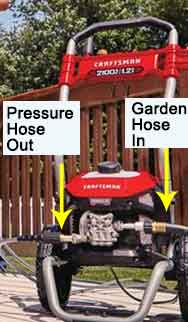 My first observation is the machine has a metal mounting base and all of the connections appear to be metal and industry standard. That's important when you need to replace hoses and nozzles, and you can't get the Craftsman brand replacement part.
 It's heavy! Over 50 pounds. The weight of this unit is because it does not have a lot of plastic parts. I had to cut it out of the box because I couldn't lift it out. However, after unpacking, the weight isn't a big deal. It has big wheels that roll easily on pavement and most surfaces. It is challenging to roll on Florida's sandy garden soil, but the answer was not to roll it into the garden.
My number one issue is the placement of water connectors. This pressure washer positions the hose intake and the pressure hose connections on the front, BUT they are on opposite sides of the system. This single feature is a safety issue for me because the hoses won't get tangled with each other or the power cable.
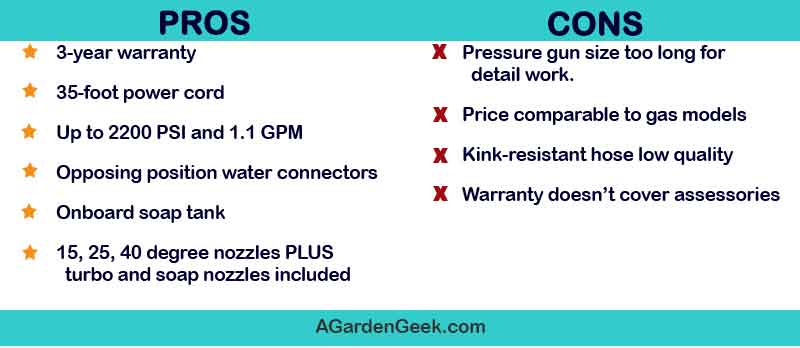
The power cable is 35 feet long. You might need an extension cord when cleaning sidewalks, but it is a manageable length. The wheels are large and roll smoothly, so the unit is easy to move
The 25-foot pressure hose is "kink-resistant," but many reviewers saw kinks and cracking within that first year and replaced the hose with a better model.
Craftsman added onboard storage for the nozzles, pressure gun, and extension wand, so each has its secure location. What is still missing is similar consideration for storing the power cord and pressure washer hose. Both components currently wrap and hang off the hook connected to the handle.
Craftsman warranties the pressure washer for 3-years. This warranty covers the engine, mounting, and casing. The warranty does NOT cover accessories. The limited warranty will not cover kinking and cracking of the pressure hose, power cord, or damage to the gun or its extension.
Ryobi 2300 PSI Electric Pressure Washer

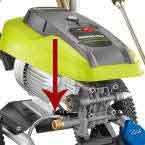
I was so disappointed to view the water connections on the Ryobi. The garden hose and pressure hose inputs are on the same side of the pump. The garden hose attaches directly below the pump on the front and above the soap container. The pressure hose connection is directly below it on the same side. My experience is that these hoses are always tied up or crossing.
 . The power cord here is a standard 35-feet long. I could still wash my patio furniture without plugging in a longer extension cord. However, cleaning my sidewalk, pool deck, driveway, or car will require that I utilize the extension cord.
 The metal chassis has large 10-inch wheels that roll easily on grass and gravel. That's a plus since the included pressure hose is only 25-foot-long, so it is necessary to move the unit frequently when cleaning large areas.
The included hose has screw-on female connections at both ends and is prone to tangling. The bad news is you will most likely want to replace it with an upgraded hose. The good new is that these screw-on connectors are industry standard so replacing it is a breeze. It would be easy and advisable to upgrade to a longer, more flexible hose with swivel connectors.
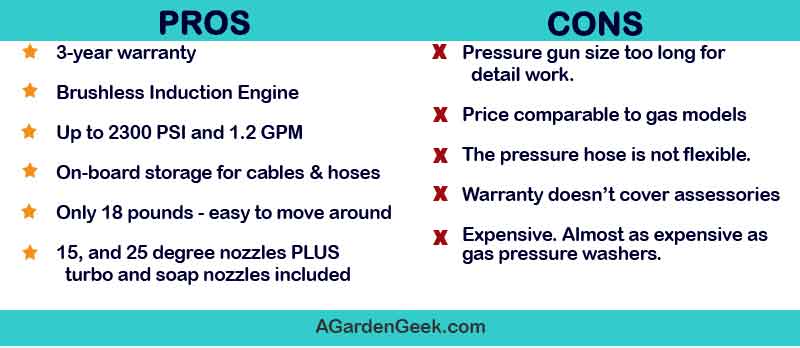
Ryobi includes three nozzles with this unit, a soap fan, a 15-degree tip, and a zero-degree turbo nozzle for cleaning wood decks, fences, or siding. There is a storage area for one additional nozzle (not included).
The on/off button is big and located directly on top of the engine. The onboard soap dispense mounts under the hose connections near the ground. But the fill spout is angled toward the front and is easily accessible for adding soap or chemicals.
Sun Joe SPX 3000 Xtreme 2200 PSI Electric Pressure Washer

This model has four nozzles that store behind the chassis handle. The included nozzles are color-coded based on pressure and use. They are gray (40 degrees) to be used for cars and furniture, green (25 degrees) for siding, fences, decks, and painted surfaces, yellow (15 degrees) that should clean most driveway and sidewalk areas, and red (0 degrees) that is a straight line, full-pressure nozzle.
A soap cannon for cleaning cars included, an all-purpose bristle brush, and a brush for cleaning wheels and rims. Although the Sun Joe Xtreme appears tailored for car detailing, it does a great job of fulfilling the primary duties of a standard pressure washer. The all-purpose brush can remove bugs and lizard marks from windows and doors. Most reviews stated the attachments are adequate, and users preferred to purchase after-market car tools.
The garden hose attaches at the rear of the washer, and the pressure hose connects at the front. Both connections are near ground level and can be awkward when rolling the washer to different locations. The designated pressure gun storage is an excellent addition, and the pressure hose storage is on the opposite side.
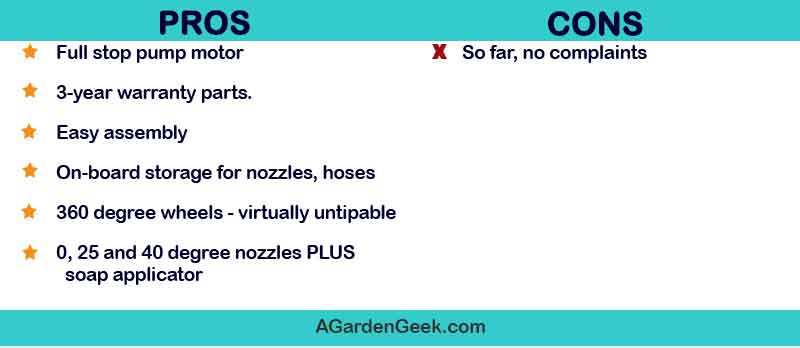
This pressure washer doesn't have the induction motor of the Ryobi 2300 reviewed above; it does have a full-stop pump motor when not in use. The full-stop feature saves wear and tear on the pump motor and is less noisy.
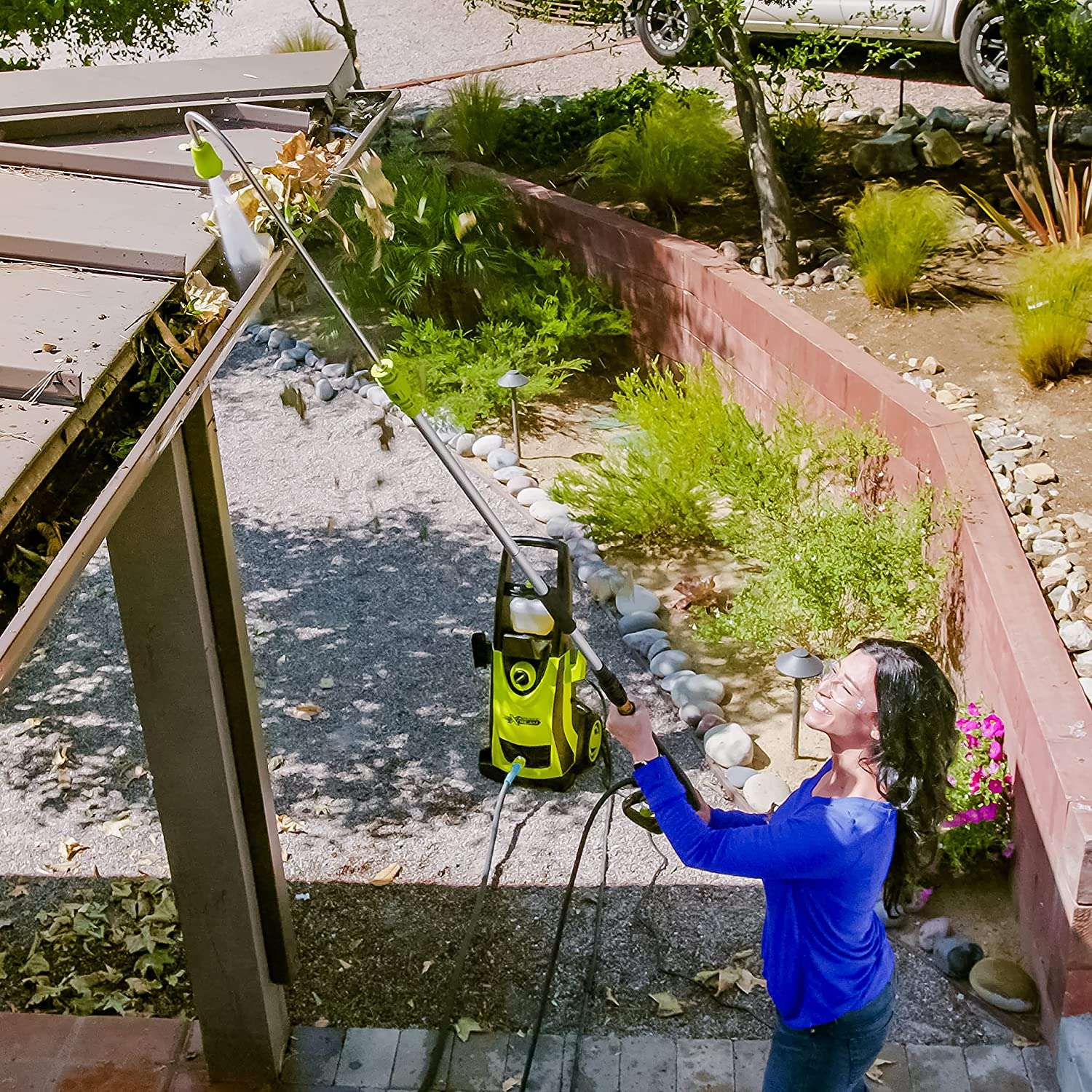 Sun Joe does a great job with optional attachments for pressure washers. The connectors are all industry standard, but Sun Joe shows a branded flat surface cleaner and gutter attachments indicating the Xtreme pressure can support those devices.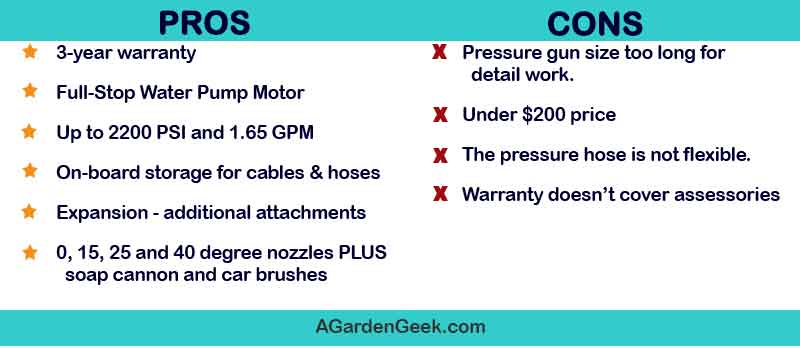
Karcher K2000 Electric Pressure Washer

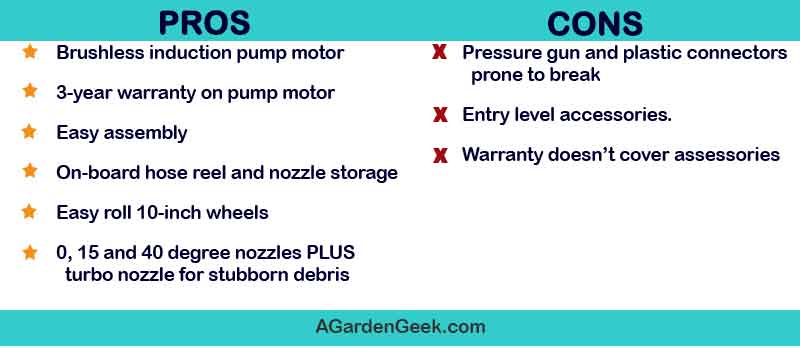
Karcher's K2000 features the brushless induction motor that shuts off the pump function when plugged in but not in use. This is an upgrade and should last to the longevity of the pressure washer. The unit feels pretty substantial when unboxing it. It weighs 25 pounds and is easy to assemble. The two large wheels easily snap on and the handle with onboard nozzle storage also clicks into place easily. There are two .5-gallon detergent tanks, an ample storage caddy, and the pressure hose storage reel that complete the setup.
My very first pressure washer was a Karcher, so I was delighted to see the garden hose and the pressure hose connect on opposing sides to avoid entanglement. New owners should plan to purchase a couple of brass quick connect valves to reduce the chance of damage to the plastic onboard connectors. Most complaints online about this unit are about failed or cracked connectors on the machine. Karcher sells a replacement for about $7, almost as if they recognize the possibility of it breaking off.
There is a 35-foot power cord that connects in the back near the right wheel. The 25-foot pressure hose is also typical entry-level and will kink with repeated use. One big improvement is the addition of a pressure hose storage reel that mounts on the handle. This makes it easier to store the hose and reduces the likelihood it will be damaged during non-use.
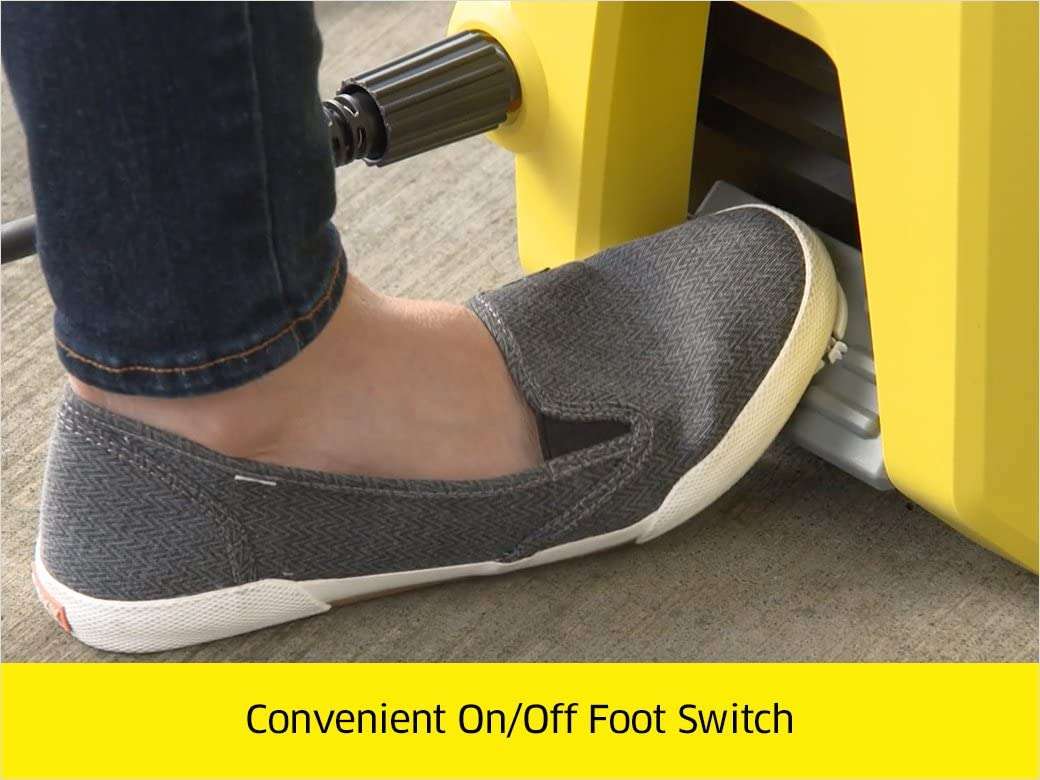 The power switch is now located at the base with a foot pedal. This makes it easy to turn the pressure washer on and off even while your hands are full. On older units, the power knob is at the bottom of the unit at the ground.
 Karcher includes four nozzles that should cover virtually all home cleanup jobs; a 40-degree is typically for cars and light cleaning, the 15-degree for pavement and bigger jobs, and the turbo nozzle that agitates to remove stubborn stains and stuck-on debris. A 65-degree soap applicator adds light suds to cars and furniture, but most users say you'll want a foam cannon for cars or a traditional bucket and scrub brush.
Karcher's website highlights a 3-year-limited warranty. The fine print explains the warranty covers the water pump, but accessories, hoses, nozzles, and those plastic connectors are only covered by the 90-days warranty.
Westinghouse ePX3050 Electric Pressure Washer

The xPX3050 has a maximum 2050 PSI and 1.76 GPM. It has a lower center of gravity and four wheels that render it almost incapable of tipping over. The 360-degree wheels operate similar to those on high-end luggage so that this unit can move in any direction. It is only 19 pounds! I had no problem unboxing it or carrying it to its first test with one hand. It moves smoothly over grass and concrete and can follow you around the car, patio, or most places with a gentle tug on the line.
The design is unconventional but user-friendly, and every accessory has its own designated onboard storage spot.
- The pressure gun and wand snap into grooves on the side.
- The power cord wraps easily around a hook on the opposite side.
- The pressure hose hangs on the back. The hose can be unhooked from the base, making draining the hose and the tanks easier.
This washer now comes with a 25-foot braided pressure hose that is less inclined to tangle and kink. All of its connectors are M22 14mm industry standard if you need something special or want to swap out and upgrade the gun or pressure hose. Westinghouse includes four adjustable nozzles, including a soap dispensing, 0, 25, and 40-degree nozzles for most applications around the house. The nozzles store away when not in use on the back of the machine. The power cable is also industry-standard 35-foot with the GFI safeguard.
The Westinghouse ePX3050 has a manufacturer's suggested price of $199, although I found it at a much lower price. The warranty is a standard 3-year on the pump and accessories. Westinghouse specifically designated in the owner's manual a 1-year parts and labor costs, and parts cost and replacement, but not labor in years 2 and 3.